
silo city
Stepping out of my truck onto the gravel and weed parking lot of Buffalo, New York’s Silo City on a muggy August day, I could feel the looming presence of the American Grain Complex. The air, unnaturally cool in the immense shadow of the silos, retained the smell of abandoned buildings. I could feel a familiar weight in my chest, the physical response to a monolithic presence, much like the feeling I had when I stood inside the ruins of the Basilica di Massenzio in the Roman Forum. A slight, sweet hint of Cheerios from General Mills downriver rippled through the air, as did the echo of my own footsteps against the concrete shafts and workhouses.
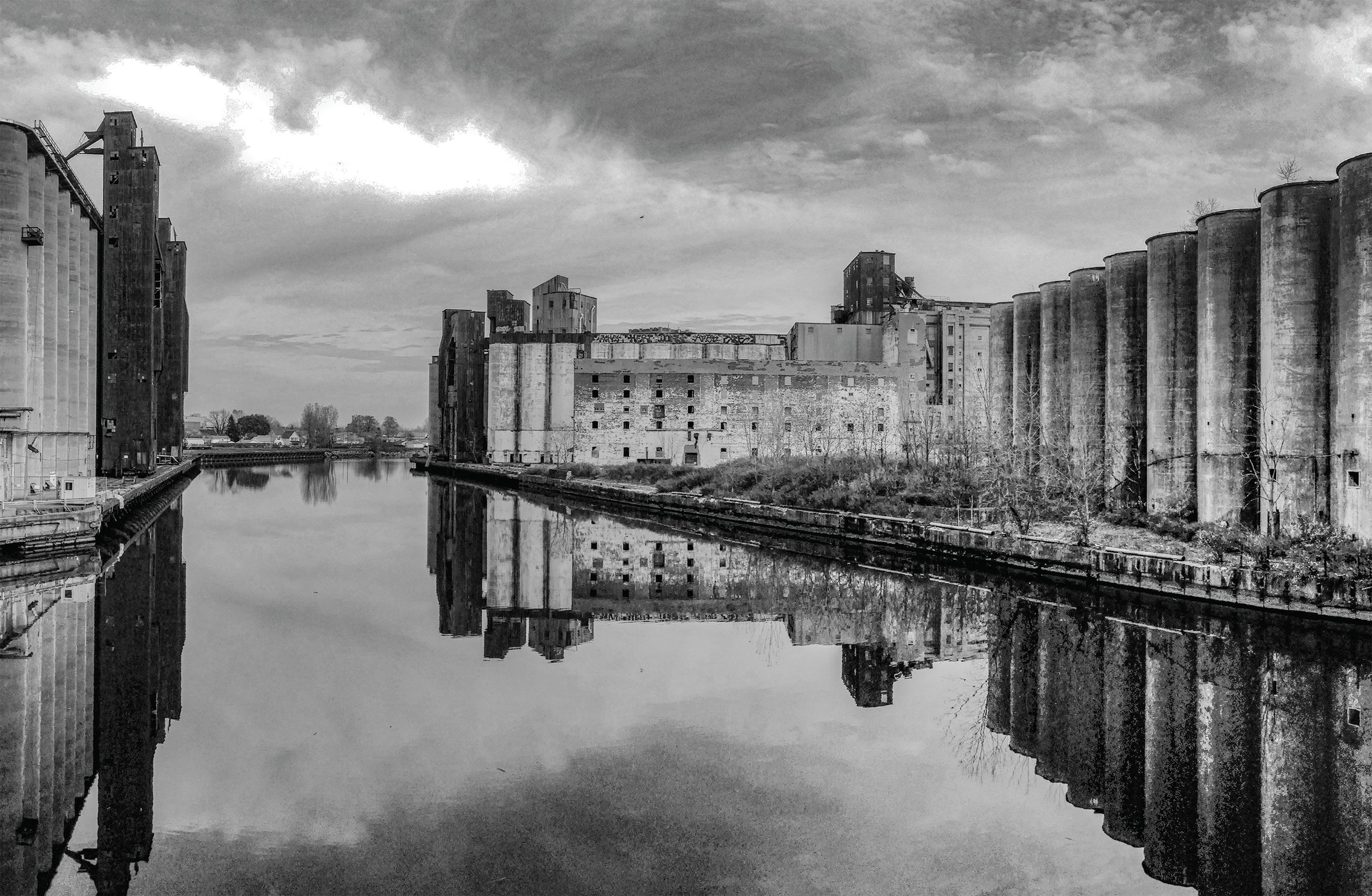
“What have I gotten myself into with this one,” lingered in my thoughts as I began to document the 275,000 square feet of the former American Malthouse. Admittedly, documentation quickly turned to exploration of my new project. There are places in Buffalo where time seems to pool instead of moving forward. The grain silos along the Buffalo River are one of those places. Their hollow concrete tubes collect and hold time like the tons of grain they were designed for. Their interiors have been quiet for decades, but their presence has always been deafening, a concrete reminder of a time when Buffalo was a global hub of industry, invention, and trade. Silo City is a place where scale alone can humble you into silence. These hulking elevators, machinery, and grain bins once fed the world. Now they stand idle, yet eerily alive, their walls saturated with stories.
In Buffalo, we do not have the Roman Forum, temples of proportion and marble. We have the grain elevators, concrete- and brick-clad machines of efficiency. These monoliths defined our skyline before steel or glass ever did or could. They shaped commerce, culture, and identity for a city which at the turn of the twentieth century was the epitome of American optimism. Such a trend-setter that future European architectural masters like Gropius and Corbusier would visit as emerging professionals to marvel at our accomplishments. Little did anyone know their sketches of our waterfront, where form follows function, would become the basis for modern thought and design impacting generations. Regionally, though, for decades, these modern muses have been treated as scars, reminders of decline rather than monuments to ingenuity. To stand inside them as a boy from Buffalo is to confront both pride and grief, abundance and abandonment. What have I gotten myself into…
For me, Silo City has always existed somewhere between ruin and possibility. My earliest impressions were of silence, vast concrete caverns where whispers could travel like cathedral bells. Later, through architectural training, I came to see them as more than ruins. I saw them as inspiration for revolutionary design principles with elegance in their simplicity. Perhaps more importantly for the community that built them, worked in them, lived with them, they were repositories of memory, not just for Buffalo, but for anyone who has ever lived in the shadow of an industrial past.
Years ago, this perspective shaped my graduate thesis, where I articulated my theory of Layered Conservation, arguing that ruins, whether in Rome or Buffalo, aren’t just remnants, but active layers of identity. They ask us to look backward and forward at once, to see what’s been erased and what still clings to life.
Now, I stood here confronted by the realities of the profession–budgets, deadlines, and building codes–while wrestling with existential design theory. My thesis literally stepping off the page and into my life. Duality has to be at the heart of Silo City, the intersection where preservation meets reinvention. As I fumbled with my flashlight, note pad, and lazer, the thought returned: What have I gotten into…
The Work of Returning
In the spring of 2019, an intimidating but familiar client called the office. It was Anthony Ceroy, now of Generation Development, and he wanted to renovate the American Malthouse and Flour Mill on the Silo City complex. Our paths had crossed before on ambitious endeavors of community creation within historic constraints and affordable parameters. First, I assisted on his renovation of the Atlantic and Pacific Warehouse building, now referred to as A&P Lofts, on the outskirts of Buffalo’s Larkinville; later, I was a project architect on the Globe Mill renovation in Utica, New York. So I knew immediately what he was asking wasn’t just architectural. It was existential. He wanted to take what seemed impossible, these abandoned machines, these artifacts of a lost economy, and make them livable again. Not as novelty lofts for the few, but as dignified, affordable homes for working people. A beacon of a new, growing community, reflective of our region’s future and grounded in its heritage.
Restoring the American Malthouse at Silo City was no ordinary project. The building was deteriorated, weathered by years of abandonment and uncertainty. Many saw only expense and impossibility. But to Anthony, there was no impossibility. He has the kind of vision that architects long for in their clients. A presence and expectation of execution that is intimidating to the uninitiated but invigorating once understood, which demands practical but unyielding success. He is a builder in the truest sense–not just of walls and windows, but of trust, community, and endurance. Despite now being a Floridian, Silo City stirred in him the emotions of his Detroit industrial lineage; he inherently understood that the Silo City complex is a series not of inert structures but of monuments to labor, resilience, and the messy history of American cities, and simultaneously of opportunities for new chapters and growth, ingenuity, and prosperity. Together, we approached the project as both an architectural and a human problem. How do you give people a dignified place to live within a ruin? How do you balance authenticity, safety, history, habitability?
We both understood the odds. Financing was fragile. Timelines stretched thin. Every detail, every window opening, every concrete repair, every brick, became a battle between history and habit, between want and necessity, perilously balanced on achievable and laughable lunacy. Here is where our partnership thrived. Anthony and I shared a belief that detail matters: not as a fetish, but as a kind of respect. To get a window reveal right in a wall isn’t about aesthetics alone; it’s about teaching a building how to breathe again, in some cases literally, with vents, to function as a healthy, sustainable project.
Every decision was a negotiation: What details could be retained without compromising performance? How could new systems thread invisibly through concrete, steel, and brick? How could affordability remain central when construction costs kept rising? The answers were rarely simple. There were nights during the design process when it felt like the weight of the structure itself, let alone the oversight of state and federal agencies and bankers, might crush the project before it saw daylight. Yet Anthony’s commitment to craft, to tenants, to Buffalo itself, kept us moving. He demanded quality not as luxury, but as justice. Affordable housing, in his vision, deserved the same care and attention as market-rate development.
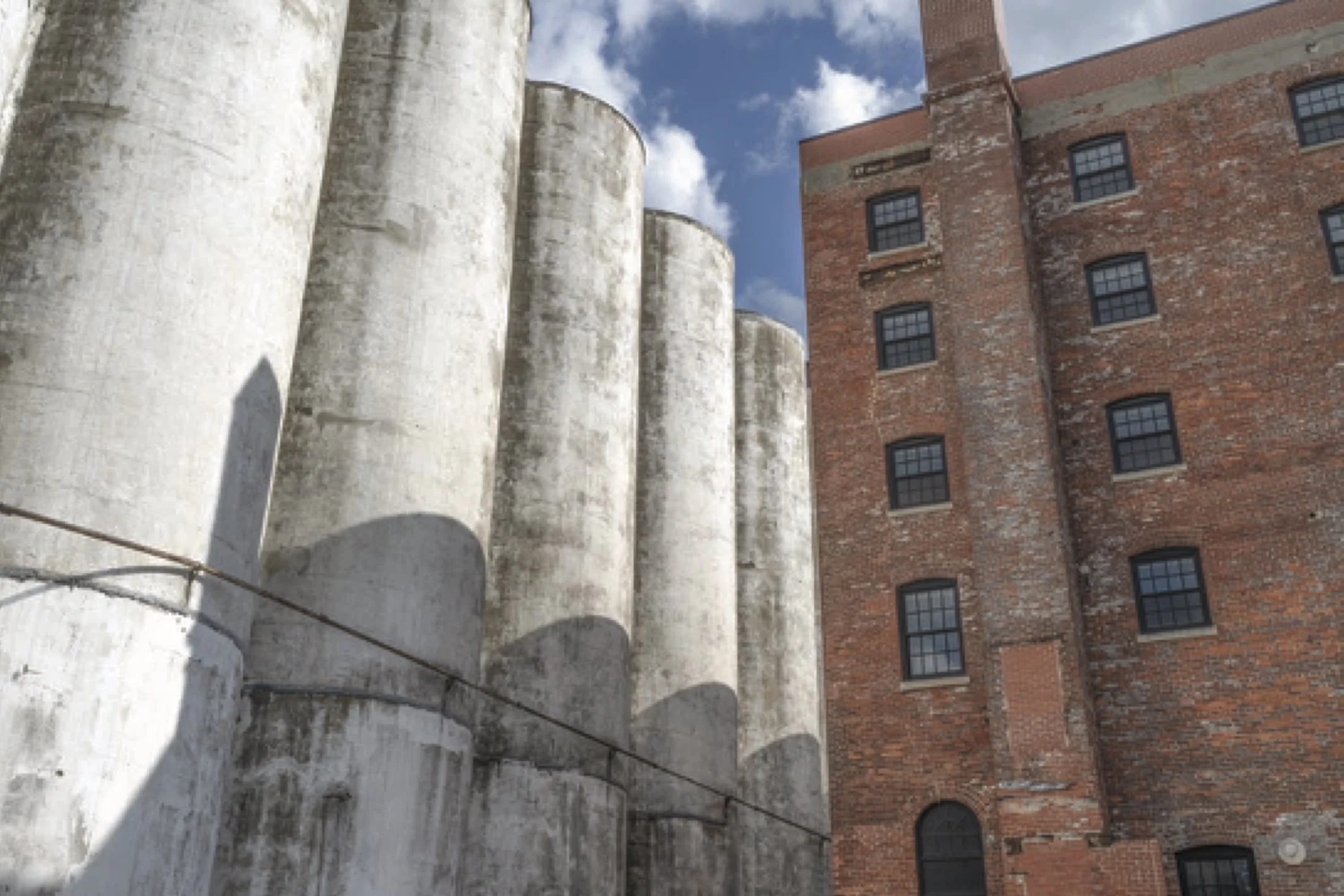
No design intervention epitomizes this more than the space that would become known as the “Silo Atrium.” A concept conceived through a whimsical embrace of the heart of the American Grain Malthouse: the eight-story finishing silos, too deteriorated to ignore but too critical to remove, which forced a decision to activate. During a late-night pandemic-forced virtual review of plans, Anthony asked, “What are we doing with these?” as he pointed his mouse at the twenty-four eight-foot-round silos identified in my plans. My uninspiring response, “Nothing, but they have to stay, they’re historic,” immediately prompted his “What could we do with them?” which stopped me in my tracks. “Wouldn’t it be cool if residents and the public could be in them? Feel them, touch them, see them at all levels?” I said. “Yes–that one!” he retorted with an emphatic finger snap and point. “That’s what I want.”
The resulting design was a first-floor exhibition and gallery space with exposed structure and hoppers, a second-floor occupiable space for poetic readings and quiet relaxation, with six stories of steel silos suspended above like an industrial wind chime, accented by lighting, with view windows revealing preserved structure, all lined by residential units looking into the grand volume. A tangible and metaphorical anchor of design, functionality, history all in one.
Roots–New & Old Inspire
The inspiration for Silo City’s design was never about pastiche or nostalgia, it was about carrying forward an attitude established by the complex’s conception and cemented by its first champion. When the design team learned the incredible history of the site, and the influence this place had on the design, we wanted to bring the conversation full circle. We looked back to the clean, modern European-style interiors I first encountered during my time abroad, where historic buildings often embraced new interventions with unapologetic clarity and subtlety. That sense of contrast and juxtaposition, respectful but confident, guided our detailing and finish palette from start to end.
At the same time, we didn’t have to look far for another source of influence. Across the street, in the former Administration Building of the American Malting Company, Rick Smith of Rigidized Metals created Duende, a bar and restaurant that lives within the rawness of its shell. There, history is not hidden, warehouse racks become tables, train rails are transformed into bar components, and the space itself wears its scars proudly. Broken speed tile walls create the backdrop for modern mixology on reused malting materials. Anchored by its past, living a contemporary existence.
This same spirit carried into Silo City. The rawness became the finish, and the historic fragments weren’t treated as relics, but as living elements slightly shifted, slightly reimagined, but never erased.
Memory as Material
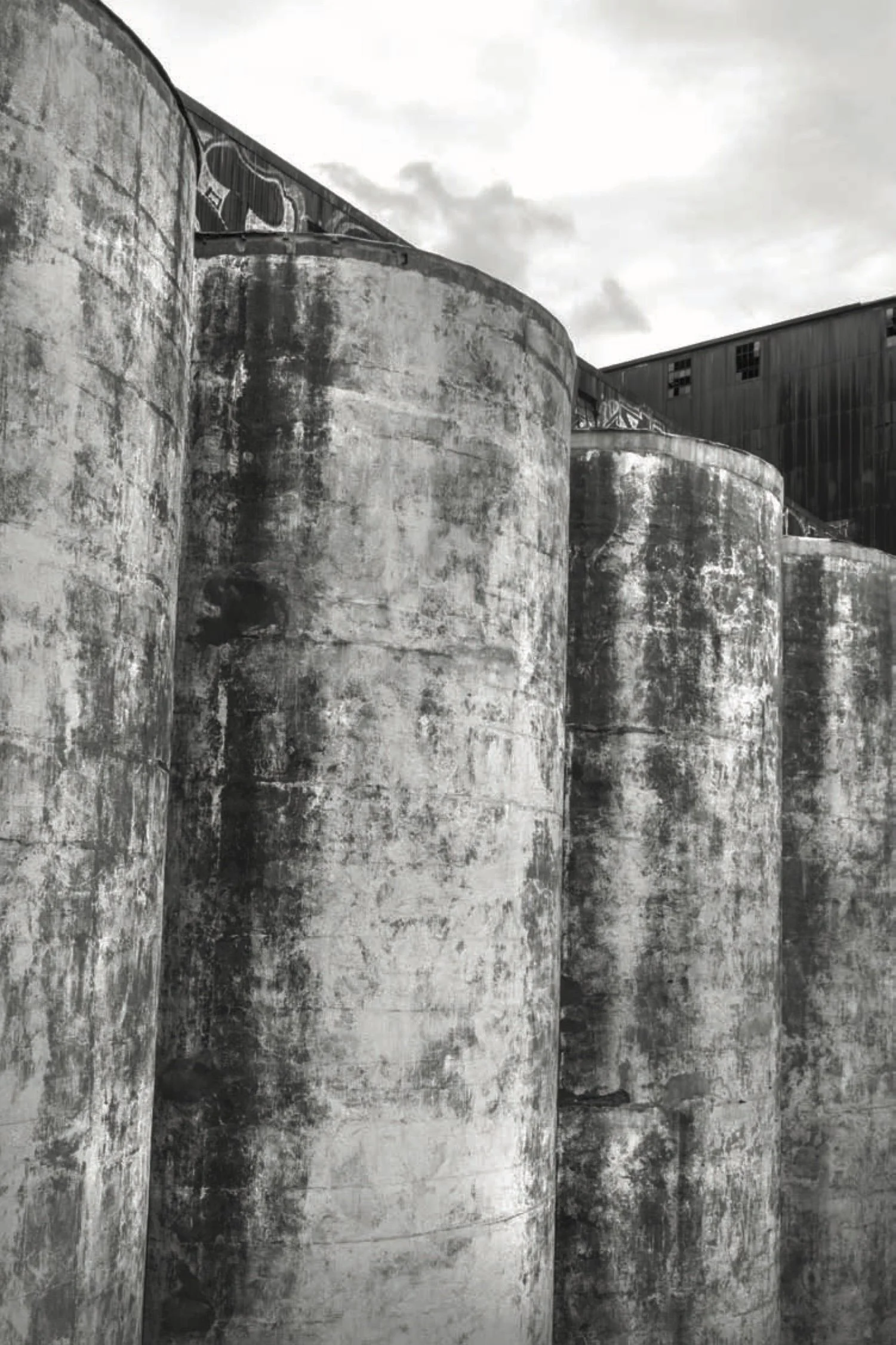
To work in Silo City is to recognize that memory itself is an intangible building material. The buildings are not blank canvases; they are vessels of memory. Every scar in the concrete, every rusted bolt, every worn stair, is a physical archive. You don’t erase that. You learn to design with it. Architecturally, the fabric posed challenges both technical and poetic. Their scale was overwhelming. Their material–poured-in-place concrete and hand-set brick walls–is nearly a century old, brittle and indestructible simultaneously. Windows were missing, roofs compromised, details eroded. But embedded in the decay were stories: tool marks from long-forgotten workers, faint shadows of machinery, graffiti from teenagers and artists, trespassing or invited during the years of abandonment.
Instead of erasing these traces, we sought to celebrate them. New interventions were threaded lightly with framing systems that respected the silos’ vertical rhythms, mechanical runs concealed without erasure, public spaces that carried forward the spirit of collective labor while providing environments for leisure and rejuvenation. The goal was not to make the building new, but to make it livable while keeping its memory intact.
That’s the paradox of preservation: you intervene by holding back. You build by choosing not to build over.
That philosophy, what I call Layered Conservation, is about holding on to strata of history without embalming them. It’s about allowing a building to evolve while refusing to deny its past. In Silo City, this meant retaining surfaces that tell their own story, even as we carved out the space for new lives. The walls remain weathered. The structures still whisper of grain and labor. Yet the interiors are adapted, softened, made habitable. It’s a balance: memory and utility, monument and home. Each time a concrete surface was cleaned, a doorway cut, or a new frame set against the rough grain of the old, it felt less like construction and more like conversation–a dialogue between eras, between ghosts and tenants yet to arrive, with us there as translators of stories told and yet to be told.
This mantra would be put to the test by the construction process. Impeded at the onset by a global pandemic, we faced mounting disbelief in the vision’s feasibility. An incessant desire for simplification and acceptance of “average at best, inferior in reality” product at an increased cost became a constant refrain that tested our conviction.
In community development, it is tempting to think in terms of architecture alone–form, proportion, material, cost. But the real test is always human scale. Who is the building for? Who gets to live here, and how?
Anthony and I pushed hard against the easy routes: to pivot and market these as luxury conversions, another chapter in Buffalo’s slow gentrification–or worse, to lower expectations and accept run-of-the-mill depressed subsidized housing. Instead, we remained committed to quality, affordable housing. That meant listening closely to original community mandates, respecting budgets, and at times adding resources to ensure quality, while resisting shortcuts and compromises that would have betrayed either the comfort or the dignity of the end users.
These grain elevators, once instruments of global commerce, have become homes for families, students, and retirees. The monumental has become intimate. A child now runs where grain once poured. A kitchen window looks out onto the same skyline that a dockworker once surveyed. This is preservation not as nostalgia, but as continuity and community.
Toward the Future
Silo City is not a singular project. It is a lesson–for Buffalo, for cities across the Rust Belt–that the great industrial ruins of our pasts are not liabilities to be erased, but assets to be reimagined. It proves that adaptive reuse is not a boutique exercise, but a necessity if we want to connect people with their histories and their futures at once. That affordable housing can be beautiful. That the silos, mills, factories, and warehouses of the Rust Belt carry a memory worth building upon.
For me, it was also personal. To walk those concrete corridors and remember my younger self, scribbling theories about ruins in Rome, trying to make sense of Buffalo’s emptiness, while learning how ideas evolve when tested against real lives. Preservation, I’ve learned, is a discipline of care. Working with Anthony sharpened that understanding. His insistence on detail, his resilience in the face of cost overruns and bureaucratic hurdles, his refusal to compromise on dignity, are qualities as essential as any technical drawing or design solution.
The silos are no longer silent. They are filled again with voices, with the smells of cooking, with music leaking through windows. They are no longer ruins. They are neighborhoods.